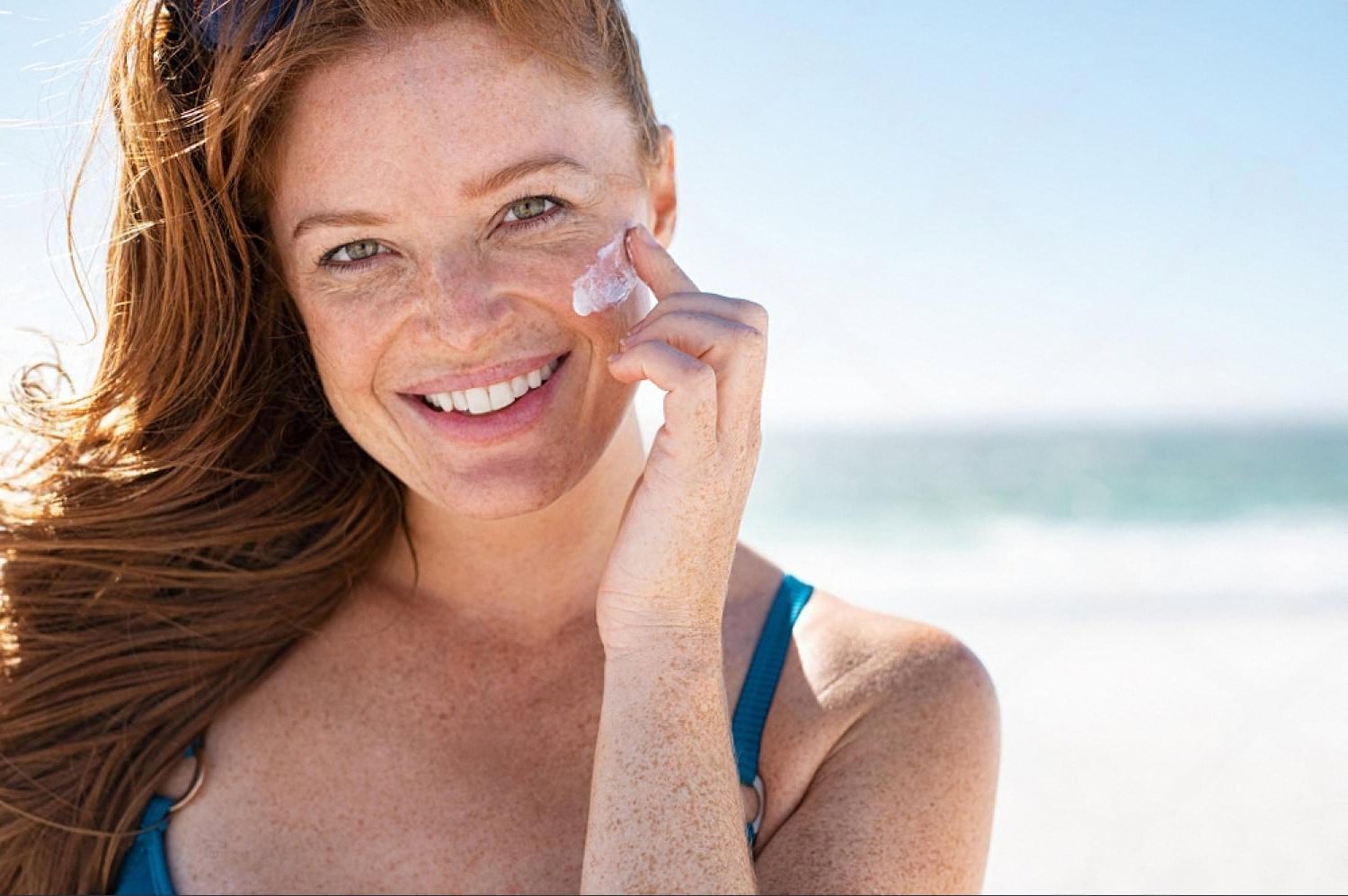
Living in the UAE means living with one of the harshest solar environments on the planet. From April through September, Dubai routinely records a UV index of 11 or higher, which the World Health Organization classifies as extreme. Even in the cooler months, midday readings often sit in the very high range. A single layer of SPF cream, applied once in the morning and forgotten about, is nowhere near enough for that kind of exposure.
The good news is that comprehensive sun protection is not complicated. It just needs to be layered, the same way you would layer defences against any other serious hazard. Sunscreen is one piece. Clothing, shade, timing, sunglasses and habit are the rest. Skip any of them for long enough in this climate, and the damage builds up quietly under the skin.
The Dubai UV Reality Check
The UV index scale tops out at 11+, and Dubai spends roughly half the year at or above that number. For comparison, London rarely exceeds 7 even in peak summer. What that means in practice is that unprotected skin here can start to burn in as little as ten minutes at midday during summer months, and pigmentation damage begins even sooner.
There is another factor most residents underestimate: reflected UV. Sand reflects up to 25% of UV radiation, water reflects around 10%, and the pale concrete and glass surfaces of Dubai amplify exposure even when you think you are in the shade. Car windows block most UVB but let a significant portion of UVA through, which is why drivers in the UAE often develop uneven pigmentation on the right side of the face and forearms.
- UVB causes surface burns and is strongest between 10 a.m. and 4 p.m.
- UVA penetrates deeper, drives ageing and pigmentation, and passes through cloud and glass.
- Cumulative damage from daily incidental exposure often outweighs the odd beach day.
Sunscreen: What Actually Works, and What Doesn’t
Before adding other layers, it helps to use sunscreen properly, because most people get this part wrong. Two common mistakes: using far too little product, and never reapplying. Dermatologists recommend roughly two milligrams per square centimetre of skin, which works out to about a shot glass full for the whole body and a generous half-teaspoon for the face and neck alone. Most people apply a quarter of that and get a quarter of the labelled SPF as a result.
Mineral vs chemical
Mineral sunscreens use zinc oxide or titanium dioxide to physically deflect UV. They start working immediately, sit on top of the skin, and are usually better for sensitive or reactive skin. Chemical sunscreens absorb UV and convert it to heat. They tend to feel lighter and blend in more easily, which matters in humid Gulf weather where a thick cream can feel unbearable. Neither category is universally better. What matters is broad-spectrum coverage (UVA + UVB) and that you actually enjoy wearing it enough to reapply.
SPF myths worth dropping
- SPF 50 does not last twice as long as SPF 25. It blocks about 98% of UVB versus 96%, but both wear off at the same rate.
- “Water resistant” means 40 or 80 minutes of protection in water, not all day. Towel off, reapply.
- Makeup with SPF is a bonus, not a substitute. You do not apply enough foundation to reach the tested SPF value.
- Darker skin still burns and still develops skin cancer. Melanin gives roughly SPF 13 at best.
Reapply every two hours outdoors, and immediately after swimming, heavy sweating or towelling. Indoors near a window, once in the morning is usually enough, but do not skip it just because you are not going to the beach.
The Layers Sunscreen Cannot Replace
Even applied perfectly, sunscreen blocks around 97-98% of UVB, misses spots, sweats off, and gets rubbed away by clothing straps and towels. In a UV 11+ environment, that leftover 2-3% still adds up. This is why dermatologists in the Gulf treat sunscreen as the last line of defence, not the first.
Protective clothing
Long-sleeved, loose, tightly-woven fabrics are the single most effective sun barrier. Look for garments with a UPF rating (UPF 50+ blocks 98% of UV). Modern UPF fabrics are lightweight and breathable, well suited to the local climate. A plain white cotton t-shirt, by contrast, offers only around UPF 5, and even less when wet.
Wide-brim hats
A cap protects the scalp and forehead but leaves ears, neck and lower face exposed, exactly the areas where skin cancers are most common. A hat with a brim of at least 7.5 cm all the way around cuts facial UV exposure by roughly half.
Sunglasses that actually block UV
UV damage causes cataracts, macular degeneration and eyelid skin cancers. Choose sunglasses labelled UV400 or 100% UV protection. Wraparound styles are best because they block reflected light from the sides. Tint darkness is not the same as UV protection, dark lenses without UV filtering are worse than nothing.
Shade and timing
The simplest rule in the UAE: if your shadow is shorter than you are, the sun is too strong for extended outdoor activity. Between 11 a.m. and 3 p.m., stay under shade whenever possible, move errands and workouts to early morning or after 4 p.m., and remember that shade reduces UV by around 50-75%, not 100%.
Cumulative Damage: The Slow Problem Nobody Talks About
A sunburn heals in a week. The damage underneath does not. Every unprotected exposure adds to a lifetime dose that shows up decades later as photoageing, uneven pigmentation, actinic keratoses and, in the worst case, skin cancer. According to the American Academy of Dermatologyone in five people will develop skin cancer in their lifetime, and the strongest single risk factor is UV exposure.
In the UAE, that risk is compounded by the year-round intensity of the sun and by how much of daily life involves incidental exposure: the walk from car to mall, morning school runs, weekend brunches on terraces, the drive along Sheikh Zayed Road with the sun beating through the windows. None of these feels like “sun exposure”, but the UV meter does not care what you call it.
This is also why annual skin cancer screening matters for anyone who has lived in the Gulf for several years, especially fair-skinned residents, people with a family history, or anyone with a lot of moles. Catching a suspicious lesion early usually means a simple in-clinic procedure. Catching it late is a different conversation entirely.
Why Daily Protection Matters Even If You Stay Indoors
A common line of thinking: “I work in an office, I’m inside all day, I don’t need sunscreen.” It sounds reasonable and it is wrong. UVA passes through standard window glass, both in buildings and in cars. Fluorescent and LED lighting emit small amounts, and even visible blue light from screens has been linked to pigmentation in recent research.
- The commute counts. A 30-minute drive with the sun on your face, five days a week, is 130 hours of UVA a year on one side of your face.
- The window seat counts. Working next to floor-to-ceiling glass in a Dubai tower is closer to outdoor exposure than most people realise.
- The quick errand counts. Ten minutes to the supermarket, twice a day, is 120 hours a year of unprotected midday UV.
- The rooftop lunch counts. Even under an umbrella, reflected UV from surrounding surfaces reaches the skin.
A daily broad-spectrum SPF 30-50, applied every morning as part of your skincare routine, handles all of this without you thinking about it. Reapply if you go outdoors for an extended period. Layer on the clothing, hat, sunglasses and shade whenever the sun is actually on you.
A Simple UAE Sun-Safety Routine
Morning
Broad-spectrum SPF 30-50 as the last step of skincare, half a teaspoon for face and neck. Don’t forget ears, hairline, and the tops of your hands.
Outdoors
Hat, UV400 sunglasses, long sleeves where practical. Reapply sunscreen every two hours. Seek shade between 11 and 3.
Yearly
Full-body skin check with a dermatologist, especially if you have moles, fair skin, or family history. Photograph anything you want to monitor.
Frequently asked questions
How often should I reapply sunscreen in the UAE?
Every two hours when you are outdoors, and immediately after swimming, heavy sweating, or towelling. Water-resistant sunscreens typically last 40 or 80 minutes in water before you need to reapply, not the full two hours.
If you are indoors and away from windows, one morning application is usually enough for the day.
Is a higher SPF always better?
Not by much. SPF 30 blocks around 97% of UVB, SPF 50 blocks about 98%, and anything above SPF 50 offers only a marginal improvement. What matters more is applying enough product, choosing broad-spectrum (UVA + UVB) coverage, and reapplying on schedule.
Mineral or chemical sunscreen: which is right for me?
Mineral (zinc oxide, titanium dioxide) sits on top of the skin, works immediately, and is generally better for sensitive skin, children, and anyone prone to reactions. Chemical filters feel lighter and blend in more easily, which many people prefer in the Gulf’s humid heat.
Both are effective when used correctly. The best sunscreen is the one you will actually wear every day.
Do I need sunscreen if I mostly stay indoors?
Yes. UVA rays pass through standard window glass in buildings and cars, so incidental exposure during commutes, near windows, or on quick errands adds up over time. Daily broad-spectrum SPF 30-50 on the face, neck and hands is the baseline recommendation for anyone living in the UAE.
How much sunscreen should I actually apply?
About half a teaspoon for the face and neck, and roughly a shot glass full (30 ml) for the whole body. Most people use around a quarter of that amount, which cuts the effective SPF dramatically. If your bottle lasts several months of daily use, you are almost certainly under-applying.
When should I get a skin cancer screening in the UAE?
Annual full-body checks are a good baseline for adults, particularly if you have fair skin, many moles, a family history of skin cancer, or years of high UV exposure. Book an earlier appointment if you notice any new mole, or an existing one that changes in size, colour, shape, or starts to itch or bleed.
Are sunglasses really that important?
Yes. UV damage causes cataracts, macular degeneration, and skin cancers on the eyelids. Choose sunglasses labelled UV400 or 100% UV protection, and ideally a wraparound style that blocks reflected light from the sides. Dark lenses without UV filtering can actually be worse than no sunglasses, because they dilate your pupils and let more UV in.

I am an award-winning freelance writer specializing in financial topics. Having more than a decade of work experience, I have published in The Wall Street Journal